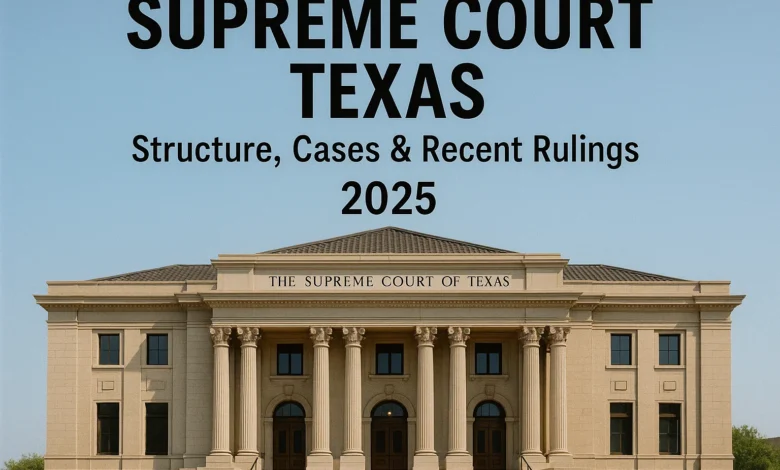
The Supreme Court Texas stands as one of the most distinctive judicial bodies in the United States. Unlike most states, Texas operates with two separate courts of last resort—the Supreme Court handles all civil matters, while a separate Court of Criminal Appeals oversees criminal cases. This unique dual-court system has shaped Texas jurisprudence since the late 19th century and continues to influence millions of lives across the Lone Star State today.
Understanding the Supreme Court of Texas matters whether you’re a legal professional, law student, or Texas resident curious about how the state’s highest civil court operates. Recent high-profile cases, including redistricting disputes that reached the U.S. Supreme Court, have brought renewed attention to Texas judicial proceedings and their national implications.


What Is the Supreme Court of Texas?
The Supreme Court of Texas serves as the final authority for civil and juvenile matters throughout the state. Established in 1846 to replace the Supreme Court of the Republic of Texas, this court has evolved significantly over its nearly 180-year history.
Located in downtown Austin near the State Capitol, the court consists of nine members: one Chief Justice and eight justices. All positions are elected through statewide partisan elections, with each justice serving six-year staggered terms.
Key Responsibilities
The Texas Supreme Court performs several critical functions:
- Provides final appellate review in civil cases involving significant legal questions
- Establishes rules for civil trial procedures and evidence
- Maintains administrative control over the State Bar of Texas
- Licenses attorneys and appoints members of the Board of Law Examiners
- Reviews cases involving attorney discipline from the Board of Disciplinary Appeals
- Answers certified questions about Texas law from federal appellate courts
- Oversees the efficient operation of the state’s entire judicial system
The court exercises discretionary jurisdiction, meaning it can choose which cases to hear based on their importance to Texas jurisprudence. This selective approach allows the justices to focus on cases that present novel legal questions or resolve conflicts among lower appellate courts.
How Texas Supreme Court Differs from Other States
Texas and Oklahoma are the only two states maintaining separate supreme courts for civil and criminal matters. This bifurcated system emerged from the Texas Constitutional Convention of 1875, when delegates recognized the massive case backlog overwhelming a single supreme court.
The Dual Court System
While the Supreme Court of Texas handles civil disputes—including contracts, property rights, personal injury claims, and family law matters—the Texas Court of Criminal Appeals serves as the final authority for criminal cases. Both courts consist of nine justices, sit in Austin, and operate independently with equal authority in their respective domains.
This separation differs dramatically from the federal system and most state systems where one supreme court handles all appeals. The arrangement has sparked debate over the years, with critics pointing to potential inefficiencies and supporters arguing that specialization allows judges to develop deeper expertise in their areas.
Election Process
Texas Supreme Court justices are elected through partisan statewide elections—a method used by only eight states. When vacancies occur between elections, the Governor appoints a replacement subject to Senate confirmation. That appointee serves until the next general election, when voters decide who completes the unexpired term.
The partisan election system means all justices currently serving on the Texas Supreme Court belong to the Republican Party, as they must win statewide races in a predominantly Republican state.
Current Texas Supreme Court Justices (2025)
As of early 2025, the Texas Supreme Court features a mix of experienced jurists and recent appointees:
Chief Justice Jimmy Blacklock leads the court after his appointment to the chief position in January 2025 by Governor Greg Abbott. Justice Blacklock first joined the court in 2018 and won public elections in 2018 and 2024.
The eight associate justices include:
- Justice Debra Lehrmann – The senior justice and longest-serving woman in court history with nearly 35 years of judicial experience
- Justice John Devine – First elected in 2012, previously served on state district courts
- Justice Brett Busby – Appointed in 2019, former appellate litigator and Court of Appeals justice
- Justice Jane Bland – Serving since 2019 with 25 years of state judiciary experience
- Justice Rebeca Aizpuru Huddle – Appointed in 2020, elected to full term in 2022
- Justice Evan Young – Appointed in 2021, former clerk to U.S. Supreme Court Justice Scalia
- Justice James P. Sullivan – Appointed in January 2025, former General Counsel to Governor Abbott
- Justice Kyle D. Hawkins – Appointed in October 2025, former Texas Solicitor General
Most current justices were initially appointed by Governor Abbott or former Governor Rick Perry before winning election to full terms. The court’s composition reflects conservative judicial philosophy, consistent with Texas’s political landscape.
Major Recent Cases and Decisions
2024-2025 Term Statistics
During the 2024-2025 term, the Texas Supreme Court heard arguments in 63 cases between September 2024 and March 2025. By June 2025, the court had issued opinions in all argued cases, demonstrating efficient case management.
The court’s reversal rate remained consistent with historical patterns—affirming only about 27.7% of cases and reversing 72.3%. This high reversal rate reflects the court’s selective case acceptance; it typically grants review only when lower courts may have erred on important legal questions.
Cases originated primarily from the Fifth Court of Appeals in Dallas and the Third Court of Appeals in Austin, though all but three of Texas’s fifteen appellate courts had cases reviewed during the term.
Redistricting Controversy (December 2025)
The most significant recent development involves Texas congressional redistricting. In December 2025, the U.S. Supreme Court allowed Texas to use a new congressional map for the 2026 midterm elections despite a lower federal court ruling that found evidence of racial gerrymandering.
The dispute centers on a mid-decade redistricting effort initiated in summer 2025 after the Trump administration urged Texas to redraw its congressional districts. The new map could add up to five Republican seats in the U.S. House of Representatives, potentially securing Republican control during the final two years of President Trump’s second term.
A three-judge federal district court in El Paso had blocked the 2025 map, ordering Texas to use its existing 2021 boundaries. The judges found substantial evidence that Texas lawmakers had racially gerrymandered the new districts. However, the U.S. Supreme Court invoked the Purcell principle—a doctrine discouraging federal courts from changing election rules close to elections—and allowed the new map to proceed.
This case illustrates how Texas redistricting issues can escalate quickly from state concerns to matters of national political significance, with the Texas Supreme Court often involved in related state-law questions even when federal courts take the lead on constitutional issues.
Notable 2024 Civil Decisions
The Texas Supreme Court addressed several significant civil matters during 2024:
Property and Contract Law – The court clarified rules regarding oil-and-gas lease royalty payments, lending practices and loan acceleration procedures, and property lease disputes affecting commercial interests.
Government Authority – Decisions examined the extent of state agency powers, school district annexation procedures, and the constitutional limits on government entities.
Professional Regulation – The court ruled on matters involving medical board authority and attorney discipline, reinforcing its role in overseeing professional licensing and conduct.
These cases demonstrate the court’s broad influence over Texas civil law, affecting everything from business operations to individual property rights.
Understanding Texas Supreme Court Jurisdiction
What Cases Does the Court Hear?
The Supreme Court of Texas exercises appellate jurisdiction over civil matters when cases present important questions of state law. The court does not retry cases or reconsider factual findings from trial courts—it reviews only whether lower courts correctly applied legal principles.
Types of cases commonly reviewed include:
- Complex business and commercial disputes
- Medical malpractice and personal injury claims
- Family law matters including custody and divorce
- Property disputes and real estate controversies
- Constitutional challenges to state laws and regulations
- Professional licensing and disciplinary actions
- Government liability and sovereign immunity questions
Juvenile delinquency cases, though considered civil matters under Texas law, also fall under the Supreme Court’s jurisdiction rather than the Court of Criminal Appeals.
Original Jurisdiction
Beyond appellate review, the court possesses original jurisdiction to:
- Issue writs of mandamus (orders compelling government officials to perform duties)
- Conduct proceedings for involuntary retirement or removal of judges
- Handle petitions related to judicial conduct and ethics
This original jurisdiction allows the court to address certain matters directly without requiring appeals through lower courts.
How Cases Reach the Texas Supreme Court
The Appellate Process
Civil disputes typically begin in trial courts—either district courts or county courts depending on the case type and amount in controversy. After a trial court decision, dissatisfied parties can appeal to one of Texas’s fourteen intermediate Courts of Appeals.
If a party remains unsatisfied after the appellate court decision, they may petition the Texas Supreme Court for review. However, the Supreme Court is not obligated to hear every petition. The court grants review when cases involve:
- Conflicts between different Courts of Appeals on legal questions
- Novel or unsettled areas of Texas law
- Significant public interest or widespread practical implications
- Potential errors by lower courts on important legal principles
A minimum of four justices must vote to grant review. If the petition is denied, the appellate court decision becomes final.
Direct Appeals
In limited circumstances, cases may bypass the intermediate appellate courts and go directly to the Texas Supreme Court. These rare direct appeals typically involve extraordinary matters requiring immediate supreme court attention.
Requirements to Serve on the Court
Texas imposes specific qualifications for Supreme Court justices:
- Must be at least 35 years old
- Must be a U.S. citizen and Texas resident
- Must be licensed to practice law in Texas
- Must have at least 10 years of combined experience as a practicing lawyer or judge of a court of record
Justices cannot stand for election after turning 75, though they may complete their current terms. There are no term limits—justices can serve indefinitely as long as they continue winning elections.
These requirements ensure justices possess substantial legal experience before joining the state’s highest civil court.
Recent Trends and Statistics
Caseload and Efficiency
The Texas Supreme Court maintains relatively efficient case processing compared to many state supreme courts. During the 2024-2025 term, the court completed all argued cases within the term year, providing timely resolution for litigants and clear guidance for lower courts.
The court’s selective case acceptance means it hears far fewer cases than intermediate appellate courts. Texas Courts of Appeals collectively issue nearly 10,000 opinions annually, while the Supreme Court hears only 60-70 argued cases per year.
Affirmance Patterns by Appellate District
Reversal rates vary significantly among Texas’s appellate districts. During the 2024-2025 term:
- The Thirteenth Court of Appeals (Corpus Christi and Edinburg) achieved a 75% affirmance rate
- The Fourth Court of Appeals (San Antonio) had a 0% affirmance rate
- The Fifth Court of Appeals (Dallas) saw its affirmance rate rise to 29.2%
These variations reflect differences in case types, legal complexity, and how well appellate courts anticipated Supreme Court jurisprudence on unsettled questions.
The Relationship Between State and Federal Courts
While the Texas Supreme Court serves as the final authority on state law questions, its decisions interact with federal courts in important ways.
Federal Court Deference
Federal courts sitting in Texas must apply state law when deciding cases based on diversity jurisdiction or when state law governs the dispute. In such situations, federal judges look to Texas Supreme Court decisions as binding authority on what Texas law requires.
When Texas law is unclear, federal courts may predict how the Texas Supreme Court would rule, or they may certify questions directly to the state supreme court for authoritative answers.
Recent Federal-State Interaction
The December 2025 redistricting dispute illustrates this interaction. While the U.S. Supreme Court addressed federal constitutional questions about racial gerrymandering, the case also implicated state law issues regarding legislative authority and election administration—areas where the Texas Supreme Court’s interpretations could prove relevant in ongoing litigation.
How to Access Texas Supreme Court Information
Official Resources
The Texas Judicial Branch maintains comprehensive online resources at txcourts.gov, where you can:
- Read recent opinions and orders
- Access oral argument recordings
- Review court rules and procedures
- Find information about current justices
- Learn about filing requirements and deadlines
Opinions are published chronologically, with the most recent decisions appearing first. The court also provides archives dating back many years.
Legal Research Databases
Comprehensive case law research requires access to:
- Westlaw and Lexis – Subscription databases with full Texas case history
- Justia and Google Scholar – Free resources providing Supreme Court opinions
- Texas Law Review and other academic journals – In-depth analysis of significant decisions
For practicing attorneys and serious researchers, subscription databases offer advanced search capabilities, citation analysis, and connections to related authorities.
Conclusion
The Supreme Court of Texas plays an indispensable role in shaping civil law across the nation’s second-largest state. From resolving complex business disputes to addressing constitutional questions that affect millions of Texans, this court’s decisions ripple through communities, businesses, and families.
Understanding how the Texas Supreme Court operates—its unique dual-court structure, selective case review process, and influential justices—provides valuable insight into Texas government and the American legal system more broadly. Recent cases involving redistricting, property rights, and government authority demonstrate the court’s ongoing relevance to contemporary issues.
Whether you’re involved in litigation, studying law, or simply interested in how Texas justice works, the Supreme Court of Texas remains a vital institution worthy of attention. As Texas continues to grow and evolve, this court will undoubtedly continue shaping the legal landscape for generations to come.
For the latest opinions, court news, and procedural information, visit the official Texas Judicial Branch website or consult with qualified legal professionals who can provide guidance specific to your situation.
FAQs
Q What is the difference between the Texas Supreme Court and U.S. Supreme Court?
The Texas Supreme Court handles only state law civil matters and has final authority on questions of Texas law. The U.S. Supreme Court handles federal constitutional questions and can review state court decisions only when they involve federal law issues.
Q How many justices serve on the Supreme Court of Texas?
Nine justices serve on the court—one Chief Justice and eight associate justices. All are elected to six-year terms in statewide partisan elections.
Q Can criminal cases go to the Texas Supreme Court?
No. Criminal cases go to the separate Texas Court of Criminal Appeals, which serves as the final authority for all criminal matters in Texas. The Supreme Court handles only civil and juvenile cases.
Q How long do Texas Supreme Court justices serve?
Justices serve six-year terms with no term limits. They can continue serving as long as they win re-election, though they cannot run for election after age 75.
Q Where is the Texas Supreme Court located?
The court sits in the Supreme Court Building in downtown Austin, immediately northwest of the State Capitol on the capitol grounds.
Read More: Top AI Avatar Creators 2025 Best Tools Reviewed & Compared